Human beings are remarkably good at fitting in.
We notice how other people speak, what gets praised, what gets laughed at, what seems acceptable and what people like us are apparently supposed to want next.
We learn the rules of the room very quickly — and there’s good reason for that.
For most of human history, belonging to a group wasn’t simply pleasant. Humans survived through cooperation. Being accepted mattered.
Our circumstances have changed dramatically since then, but our sensitivity to belonging remains remarkably effective.
And somewhere inside that process sits something we rarely notice operating: identity.
The person you learn to be
When I talk about identity, I don’t mean a personality test or the labels in a biography.
I mean the internal understanding you carry of who you are: what someone like you does, what seems sensible, what would be embarrassing, where you belong, what you are entitled to want and what someone like you is allowed to become.
That understanding quietly influences an extraordinary number of ordinary decisions.
Someone who sees themselves as the dependable one says yes.
Someone who has always been the sensible one hesitates over the risk.
Someone who thinks I’m not creative may dismiss an idea before discovering whether they enjoy it.
We think we are evaluating the decision.
Sometimes we are simply staying in character.
Identity is shaped before it is chosen
Most of us didn’t sit down at eighteen and deliberately design an identity.
It develops through family, school, culture, success, failure, praise, embarrassment, the people whose approval mattered and the groups we wanted to belong to.
I can see this clearly in my own life.
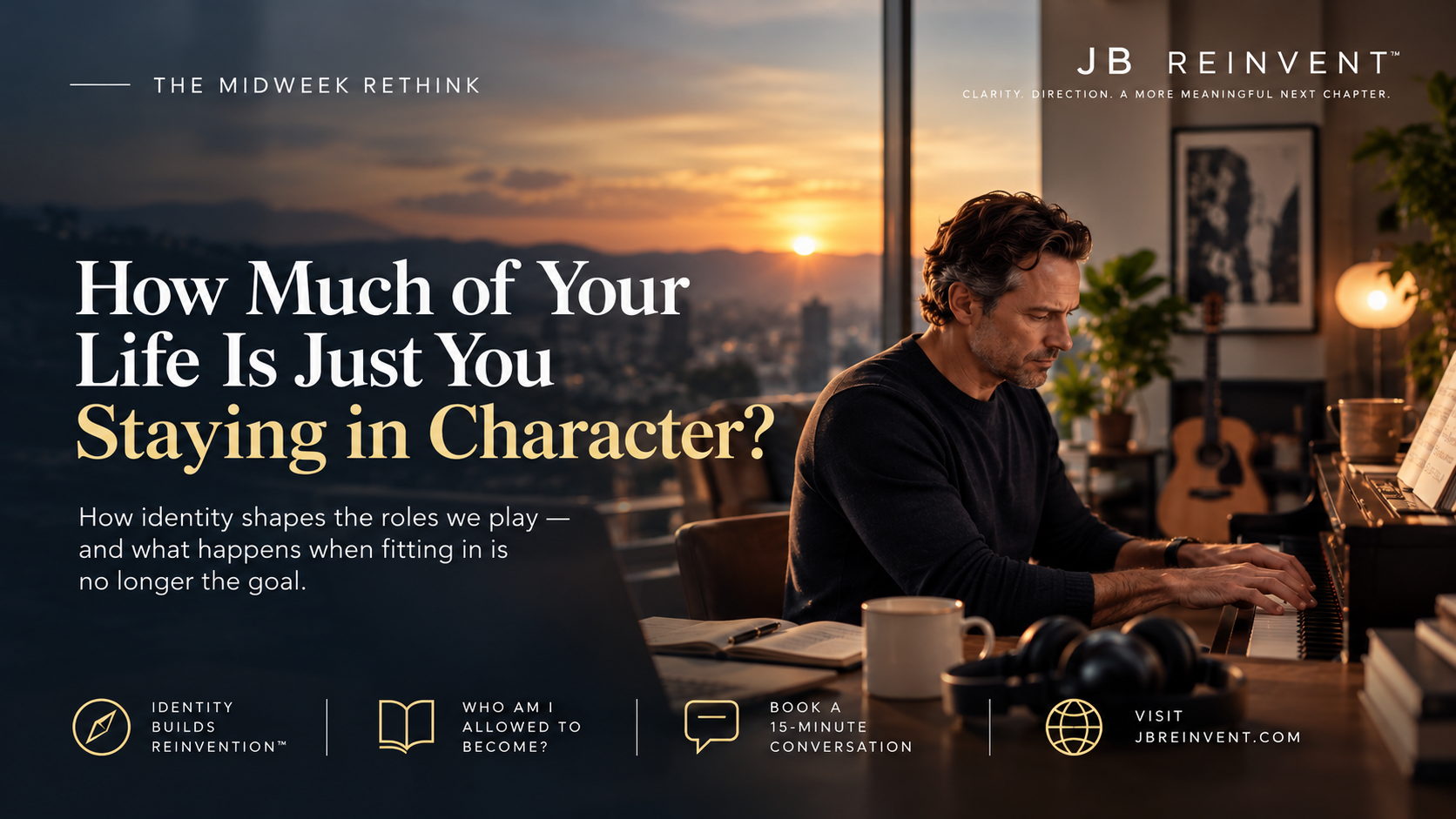
I started playing piano when I was young and continued with music through school. I loved it.
Then adult life filled up.
Work became more demanding. Other responsibilities took their place. Music didn’t disappear because I stopped loving it; it simply became something for which there was no longer much room.
For years, I could have framed that quite simply: I had a career, I wasn’t going to resign and become a full-time musician, therefore music belonged in the past.
But that was a false choice.
Recently, music has found its way back into my life differently. I create it, experiment with lyrics and styles, and share some of it through Instagram.
I’m not trying to become a professional musician.
I’m giving an important part of myself somewhere to exist again.
That is a form of reinvention too.
Organisations do this as well
The corporate world has its own version of identity: this is how we do things here.
That creates consistency and cohesion — until the environment changes.
Then the same culture that once helped an organisation succeed can start protecting yesterday’s model.
Companies can introduce new structures, technology and strategy while still rewarding old behaviours.
People can do exactly the same thing.
The environment changes. You change. But the internal rules remain.
A role that once gave you belonging may stop fitting. Something you genuinely value may disappear because it no longer fits the identity that became dominant.
And eventually a different question appears.
Not:
How do I fit in here?
But:
Do I still want to?
The problem is not always that you cannot fit in.
Sometimes the problem is that you can — and no longer want to.
You may still know exactly how to succeed in the environment. You may even be very good at it.
But competence and alignment are not the same thing.
Change the identity, not just the plan
This is why I believe identity is fundamental to lasting reinvention.
We tend to approach change through outcomes:
I want a different career.
I want better boundaries.
I want to write.
I want to make music again.
So we create a plan.
But plans continually compete with the person we already understand ourselves to be.
Sustainable change becomes easier when the identity begins moving too.
Not simply:
I should make more time for music.
But:
Music is part of my life.
Not:
I must finally make time for this ambition.
But:
This is part of the life I am building.
That principle sits at the heart of Identity Builds Reinvention™ and the work I do through JB Reinvent™.
Because making change is one thing.
Making it stick is another.
And sometimes the obstacle is not the plan.
It is the person you learned you had to remain.
So here is a question worth noticing this week:
When you hear yourself say, “I’m just not the kind of person who…” — who decided that?
And perhaps the more useful question:
What part of you has been waiting for permission to become relevant again?
James Bradley is the author of Who Am I Allowed to Become? and founder of JB Reinvent™.
Read the book on Amazon, explore JB Reinvent™ and its programmes at jb-reinvent.com, or tell me in the LinkedIn comments:
What part of yourself would you like to make more room for again?
Article links: Who Am I Allowed to Become? | JB Reinvent™ | Signature Programme